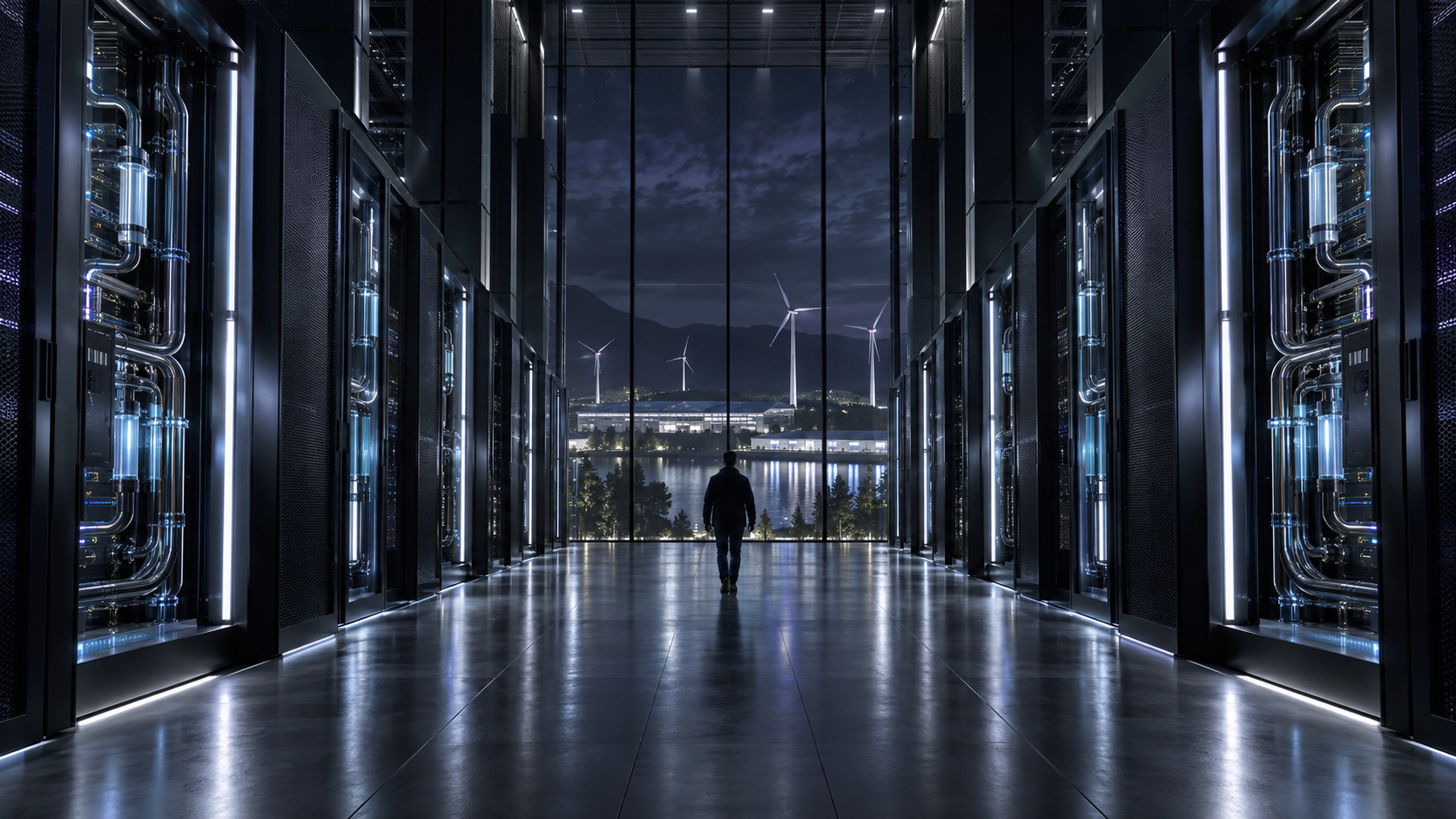
Artificial intelligence may feel weightless at the point of use, but every answer has a physical address. The next generation of data centres will be judged by the intelligence of the whole system: compute, energy, cooling, location and the communities around them.
The interface to artificial intelligence can be a sentence spoken into a phone. Behind that sentence sits one of the most consequential infrastructure programmes of the modern era. Land, power, water, networks, materials and specialised engineering are being assembled into facilities that manufacture intelligence at extraordinary scale.
Compute becomes a place
For most users, computing has become invisible. The cloud encouraged the idea that digital capacity exists everywhere and nowhere. Artificial intelligence makes the physical reality impossible to ignore. Advanced systems require dense computing, fast networks, dependable power and an operating environment engineered around heat.
This changes the meaning of a data centre. It is no longer only a technical utility at the edge of a business. It becomes strategic infrastructure, shaping where new capability can be developed and how reliably it can be delivered.
Energy is part of the architecture
The critical design question is not simply how much energy a facility consumes. It is when that energy is needed, where it comes from, how demand interacts with the surrounding grid and whether the site can adapt as both computing and generation change.
A more intelligent facility would coordinate workloads, storage, cooling and available power rather than treating them as separate engineering problems. Flexible operation will matter alongside efficiency, particularly where demand is growing faster than local infrastructure can be expanded.

“The data centre of the future is not simply a building full of machines. It is an energy, computing and civic system operating as one.”
Cooling becomes a systems problem
As computing density increases, moving heat becomes as important as moving data. Cooling choices affect building form, equipment design, water strategy, maintenance and the opportunity to reuse heat elsewhere.
The strongest solutions will be specific to their location. Climate, energy mix, water availability, network access and surrounding demand all change the answer. The future will not be won by one universal building copied onto every site.
A facility has to earn its place
Large infrastructure arrives inside an existing community. It competes for land and grid capacity, creates construction and operational impacts, and may also create new skills, investment and forms of energy cooperation. A credible project has to explain that exchange clearly.
This is where property, technology and public purpose meet. Better projects can begin with the place itself: what the region can support, what the facility can return and how the design can improve rather than simply occupy its environment.

From data centre to intelligence factory
The phrase intelligence factory reflects an important shift. These facilities do not merely store information. They transform energy, silicon, data and models into a capability that can be distributed across economies and daily life.
The leaders in this field will think beyond racks and megawatts. They will connect computing architecture with energy systems, resilient places and responsible access to the intelligence being produced. The physical foundation of artificial intelligence deserves the same imagination as the models running inside it.